Study Skills That Stick: Focus, Memory, and a Weekly Plan
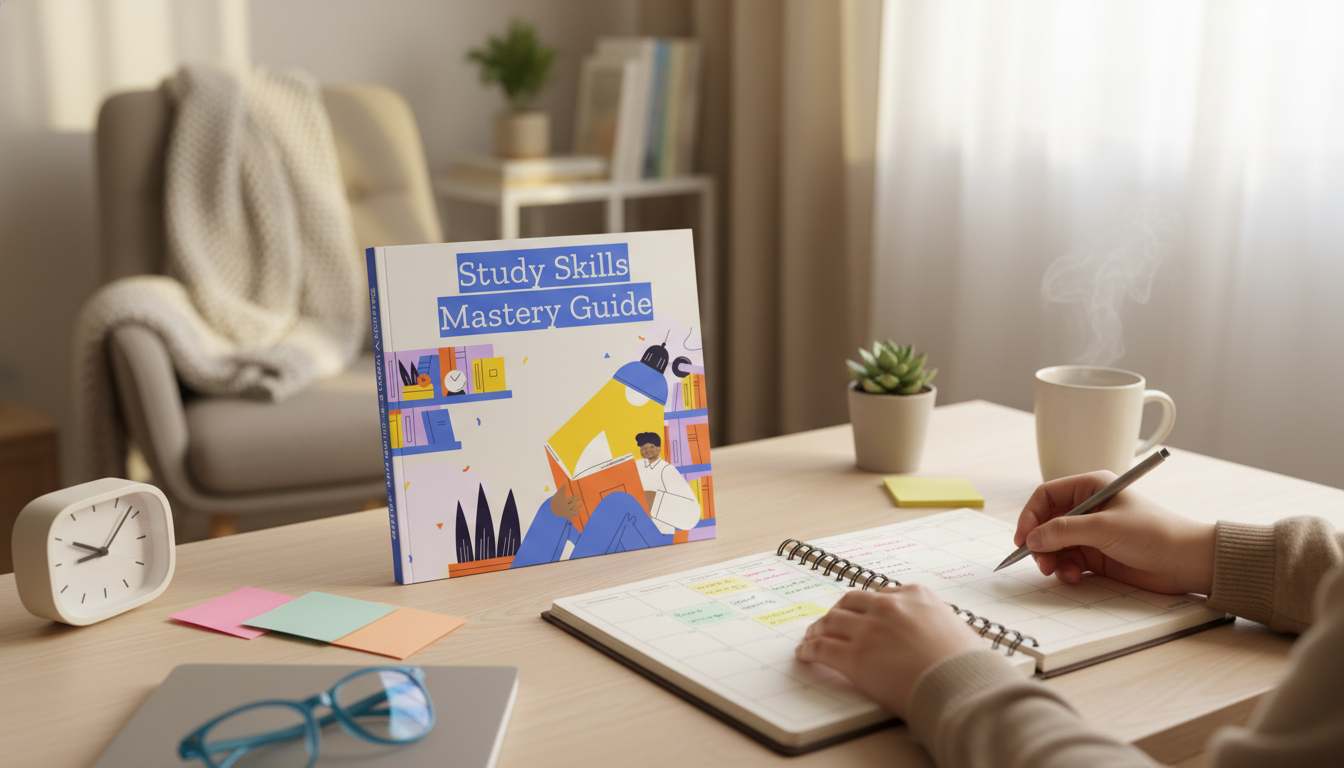
Study Skills Mastery Guide: Practical Methods for Focus, Memory, and Better Study Sessions
Strong study skills come from small systems you can repeat: clear outcomes, focused work blocks, active recall, spaced review, and a simple way to track what matters. When the process is consistent, studying feels less like willpower and more like a workflow you can start on autopilot. The goal is simple: remember more, stress less, and walk into tests knowing you’ve practiced the exact skills you’ll be graded on.
What “good studying” actually looks like
Effective studying is less about time spent and more about what your brain is forced to do during that time. Rereading and highlighting can create familiarity, but tests require recall and application.
- Prioritizes understanding and recall over rereading and highlighting
- Uses short, focused sessions with planned breaks to reduce mental fatigue
- Builds memory through spaced repetition and frequent low-stakes quizzes
- Tracks progress with a checklist so nothing important is missed
- Balances workload across the week to avoid last-minute cram cycles
Research reviews consistently rank practice testing and spaced practice among the most effective learning techniques (Dunlosky et al., 2013). In practical terms: spend less time “going over” notes and more time trying to retrieve answers without looking.
Set up a study session in 10 minutes
A fast setup prevents the two biggest session-killers: uncertainty (“What should I do?”) and friction (“Where are my materials?”). In 10 minutes, you can turn a vague plan into a concrete sequence you can execute.
- Choose a single outcome: a solved problem set, a self-quiz score, or a completed outline
- Collect materials before starting (notes, slides, textbook pages, assignment prompts) to avoid mid-session distractions
- Break the task into 2–4 micro-steps (example: “review formulas” → “do 10 practice problems” → “self-check errors”)
- Pick a time box (25–45 minutes) and schedule a short break (5–10 minutes)
- End by writing the next step to make restarting effortless
10-Minute Study Session Setup Checklist
| Step | What to do | Example |
|---|---|---|
| 1 | Define the outcome | Score 8/10 on a self-quiz |
| 2 | Gather materials | Slides + notes + practice questions |
| 3 | Create micro-steps | Outline → recall test → corrections |
| 4 | Set a timer | 35 minutes work + 7 minutes break |
| 5 | Write the restart note | Next: redo missed questions |
Focus tips that work when motivation is low
Low motivation usually means your environment and your task are asking too much at once. The fix is to reduce inputs, shrink the starting step, and protect attention for one block at a time.
- Use an “open loop” list: write distracting thoughts on paper and return to studying immediately
- Reduce friction: keep only the needed tab/app open; put phone in another room or use Focus mode
- Start with a 2-minute “warm-up”: rewrite the goal, skim headings, and begin the first micro-step
- Match difficulty to energy: do recall practice when fresh; do formatting/organizing during low energy
- Try structured cycles (Pomodoro-style) but adjust timing to your subject (math often benefits from longer blocks)
Study methods that improve retention (not just familiarity)
The strongest methods create “desirable difficulty”—not struggle for its own sake, but just enough challenge that your brain has to retrieve, compare, and apply. The testing effect (retrieval practice) is a well-supported example (American Psychological Association overview).
Fast method picker
| If the task is… | Best method | Quick way to do it |
|---|---|---|
| Definitions, terms, formulas | Active recall + spaced repetition | Flashcards + short daily reviews |
| Explaining concepts | Elaboration | Teach-back in 5 sentences |
| Problem solving | Practice tests | Timed sets + error log |
| Confusing similar topics | Interleaving | Alternate question types in one set |
Memory techniques for exams and heavy reading
If note-taking is part of your workflow, the Cornell format can make review easier by naturally turning notes into questions and summaries (Cornell University: Cornell Note-Taking System).
A weekly plan that prevents cramming
Simple weekly rhythm (example)
| Day | Session focus | Typical length |
|---|---|---|
| Mon | Learn + quick recall | 45–60 min |
| Wed | Spaced review + flashcards | 30–45 min |
| Fri | Practice questions + error log | 45–75 min |
| Sun | Mixed review + plan next week | 30–60 min |
Printable checklist and ready-to-use templates
For a structured, downloadable set of learning strategies, focus tips, study methods, memory techniques, and a study checklist PDF, see: Study Skills Mastery Guide (Digital Download).
If stress is interfering with consistency, a short daily calm routine can help: Mindful Moments (Digital Guide).
For quick reset routines that fit real-life chaos (especially in busy households), see: Breathe, Mama, Breathe (Digital Download).
Mini study checklist
| Before | During | After |
|---|---|---|
| Choose outcome | Recall from memory | Correct mistakes |
| Gather materials | Work in time box | Schedule next review |
| Remove distractions | Short break | Update checklist |
Common obstacles and quick fixes
FAQ
What study method works best for long-term memory?
Active recall combined with spaced repetition is a strong baseline: test yourself the same day, review again 2 days later, then again 1 week later. Adding practice tests speeds up retention because you rehearse retrieving and applying information under realistic conditions.
How many hours should a student study each day?
It depends on course load and goals, but consistency and quality matter more than marathon sessions. Many students do well with focused blocks totaling about 30–90 minutes per subject across the week, rather than long, unfocused daily studying.
Are digital study guides effective compared to making your own notes?
Digital guides can be very effective when they provide structure and proven methods, especially for planning, checklists, and review schedules. Results are best when you use the guide to do active tasks—self-quizzes, practice sets, and error logs—rather than passively reading.
















Leave a comment